
Stainless steel laboratory worktops
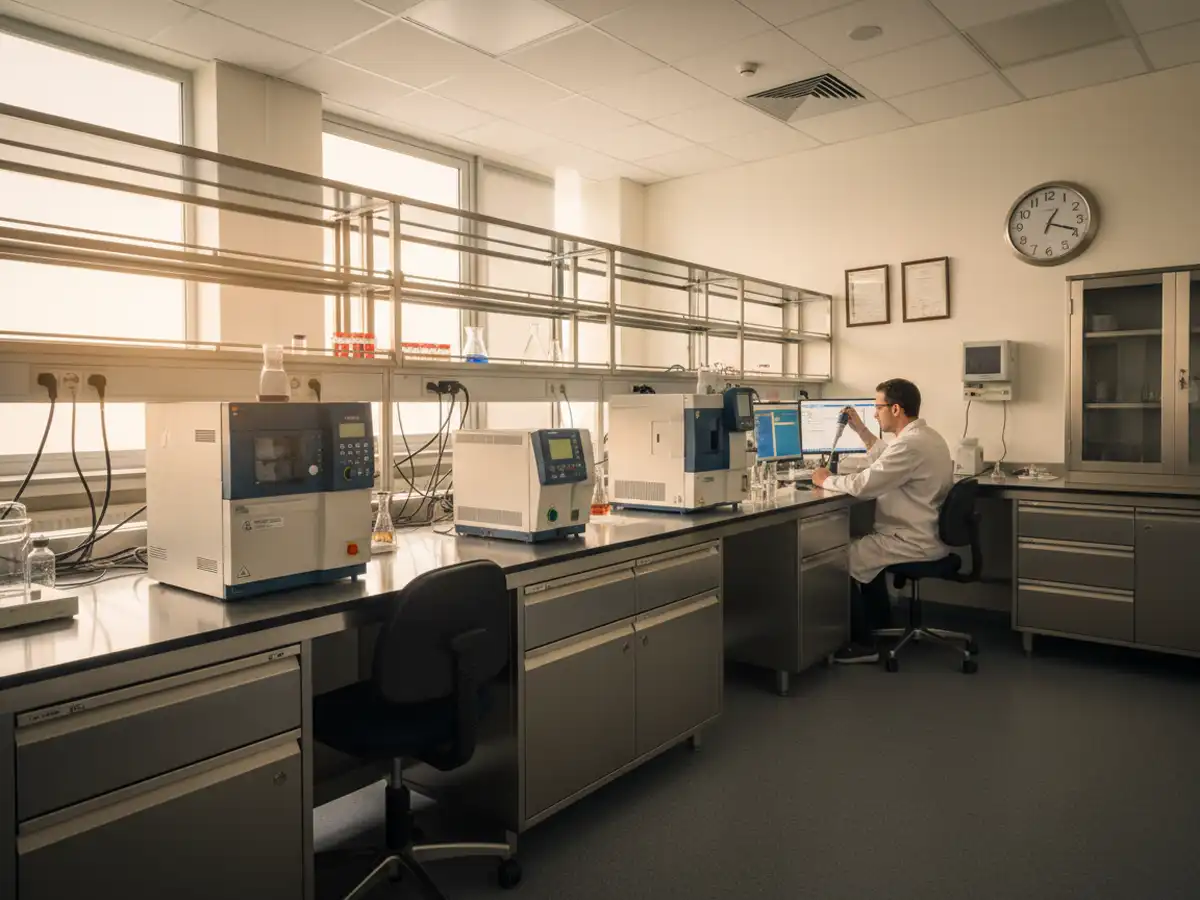
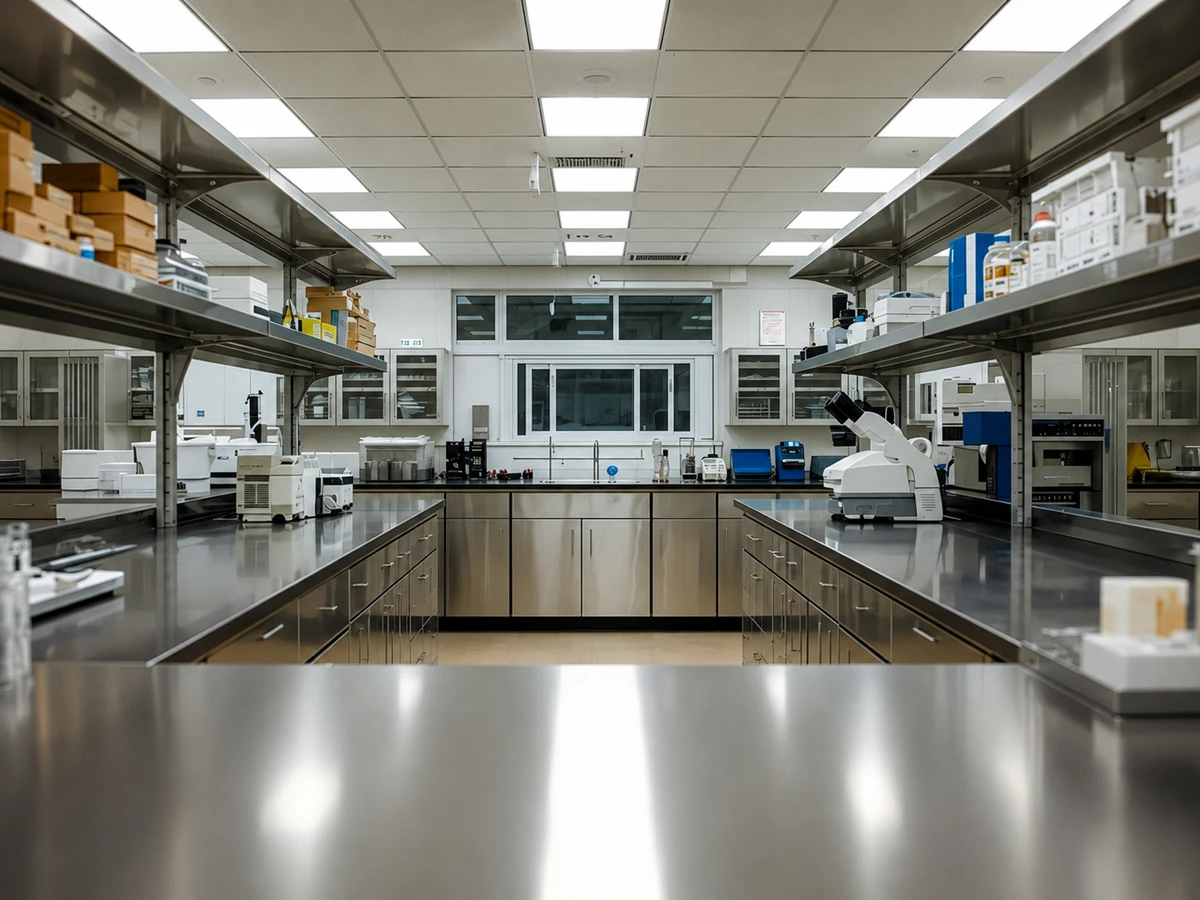
Laboratory worktops are required to withstand demanding conditions that would quickly degrade many conventional surface materials. Stainless steel remains one of the most widely specified options throughout scientific, medical, pharmaceutical and industrial facilities due to its combination of chemical resistance, hygienic properties, structural strength and long service life. Engineered to comply with stringent ISO cleanroom standards and Good Laboratory Practice (GLP) protocols, custom metal worktops provide an unyielding, non-combustible barrier that ensures zero risk of cross-contamination or chemical leaching during critical test procedures.
The grades most commonly specified are 304 and 316 stainless steel. Grade 304 is suitable for many laboratory environments, whilst grade 316 offers enhanced resistance to chlorides and more aggressive chemicals. Both provide excellent resistance to moisture, staining and routine exposure to laboratory cleaning agent. The addition of molybdenum in 316 grade alloy delivers vital defence against pitting and crevice corrosion when handling saline solutions, hydrochloric acids, and harsh vapourised hydrogen peroxide (VHP) decontamination cycles. When requesting a quotation, the fabricator can advise on the ideal grade and gauge based on your specific chemical exposure profiles.
From a specification perspective, laboratory work surfaces are typically fabricated from 1.2mm, 1.5mm, or heavy-duty 2.0mm gauge sheet (austenitic 304 grade for general analytical use, or 316 grade for high-chloride, acidic, or saline environments) finished to a controlled satin polish (typically 240–320 grit, achieving an average surface roughness of $Ra < 0.5\,\mu\text{m}$ to inhibit microbial adhesion). Sections are fully TIG-welded using inert gas shielding and matching low-carbon filler wire, followed by post-weld pickle passivation to fully restore the protective chromium oxide boundary layer across all heat-affected zones. Worktops can be bonded directly to Class 0 / Euroclass A1 non-combustible moisture-resistant sub-cores or mounted onto rigid, open box-section 304-grade steel tubular box underframes (typically 40mm x 40mm or 50mm x 50mm) fitted with vibration-dampening acoustic pads and heavy-duty M12/M16 stainless adjustable levelling feet to ensure rock-solid stability under heavy centrifuge and spectrometer loads. Furthermore, perimeter details can be factory-formed with integrated coved upstands featuring a minimum internal radius of 10mm to 15mm, fluid-retaining marine edges up to 6mm proud of the deck, and pre-punched service knockouts for vulcanite chemical wastes, gas taps, deionised water outlets, and data raceways, ensuring seamless integration on site and full alignment with BS EN 14056 and ISO 14644 cleanroom compliance.
Laboratory environments routinely involve contact with acids, alkalis, solvents, disinfectants and other potentially corrosive substances. The naturally occurring chromium oxide layer on stainless steel provides protection against corrosion and enables the surface to withstand repeated cleaning without deterioration. Unlike porous materials, it does not absorb liquids or harbour contaminants, making it particularly suitable for controlled environments where cleanliness is essential. Laboratories don’t just need clean worktops; they need clean rooms, which is where seamless metal wall cladding comes in. Integrating custom continuous wall panels with your worktops creates a fully hermetic, washable envelope that withstands high pressure washdowns and autoclave steam venting without joint failure.
These characteristics make stainless steel an established choice within pharmaceutical manufacturing, biotechnology, microbiology, pathology and healthcare laboratories. In such settings, surfaces must support stringent cleaning protocols whilst minimising the risk of contamination. Welded construction can further improve hygiene standards by eliminating joints and crevices where debris or bacteria may accumulate. Precision TIG welded radiused coving can be folded directly into integrated rear upstands and front drip lips, removing internal 90 degree dirt traps and ensuring every square millimetre can be sterilised rapidly.
Because chemical resistance is critical, these surfaces can be fabricated with hygienic welded-in stainless sinks to prevent dangerous fluid pooling. Fabricators can incorporate integrated wet sinks with sloped drainer planes, acid resistant bottle traps, overflow weir dams, and laser-cut cutouts for chemical taps, pure water outlets, or emergency eye wash stations.
Research institutions, universities and analytical laboratories also benefit from the material’s durability and versatility. Whether used for chemical analysis, environmental testing, food science, quality control or academic research, the surface provides a stable and dependable working platform capable of withstanding intensive daily use. Worktops can be customised with raised anti spill marine containment edges around the perimeter, safely capturing accidental hazardous spills before liquids can run onto the floor or base units.
Engineering laboratories and industrial testing facilities frequently specify stainless steel due to its mechanical strength and dimensional stability. Heavy equipment, analytical instruments, testing apparatus and prototype assemblies can be supported without risk of distortion, whilst the surface remains resistant to oils, coolants, lubricants and cleaning chemicals commonly encountered in technical environments. Heavy-duty box section underframes, vibration-damped sub-bases, and adjustable levelling feet can be engineered into the benches to support ultra-sensitive balances, spectrometers, and centrifuge machines without harmonic resonance.
A further advantage is longevity. Well-manufactured laboratory worktops can remain fully operational for decades with minimal maintenance. Their resistance to impact damage, abrasion and corrosion helps reduce lifetime ownership costs, whilst the absence of timber-based substrates eliminates problems associated with swelling, delamination and moisture ingress. Unlike resin or epoxy worktops that can suffer brittle fractures under thermal shock or heavy tool drops, steel absorbs high mechanical loads and can be repolished in situ to restore its uniform surface grain.
For laboratories where reliability, hygiene and chemical resistance are fundamental requirements, stainless steel continues to provide a proven and technically robust solution across a broad range of scientific, medical and industrial applications. To configure bespoke worktops for your facility, simply upload your technical drawings, run lengths, or equipment schedules via our Quotation Request Form to receive a comprehensive, specification-grade quotation.